What is it that we have not allowed ourselves to feel?
what is not ok?
if we only knew, the piercing unlocks the clouds
let it rain
Given my orientation towards both ecology and inner life, the poem Clouds in Each Paper by Thich Nhat Hanh really speaks to me. What it evoked in me was the connecting of the somatic life with ecocide. In the way of animism, there is no schism.
Tashi lahas always had a jovial sense of humor in the time I've known him. In this case, he was describing his teacher's disagreement with the modern cultural approach of 'no pain, no gain.' After years as adevoted practicing Catholic, and decades as a monk, he came across his teacher, Kyabje Tashi Norbu, who was a lineage holder in the Jonang Vajrayana (Tibetan Buddhist) tradition.
Tashi ladescribed the decades he spent meditating in his previous tradition as one of a wandering - he would go to his teacher after weeks of silent meditation, and ask 'what is the right way to practice?' and the enthusiastic response would come back - 'that's it!' meanwhile he is thinking 'WHAT'S IT?!
The Jonang approach was quite different, in a variety of ways. It was named about 1000 years ago as a rediscovery of Dolpopa Sherab Gyaltsen, a monastic following the lineage of Maitreya, Nagarjuna, Asanga, and Vasubandhu, and originally, the Buddha. The first monastery was in Jomonang, Central Tibet, and so 'Jonang.' A couple of notable points about it below.
First is the core of the teaching that stands out - the concept of 'shentong' - or 'other emptiness' - which interestingly aligns quite strongly with my experiences of the teachings of Master Hua's conception of Chan. Shentong names that while 'ultimate reality' cannot be described or understood on 'this side of the mind,' that does not imply nothingness - and in fact nothingness can be quite a pitfall in understanding as it can lead to design patterns of nihilism. That's part of why the lineage translates to the 'Great Middle Way' - great because of it's width, that all are included as Buddha(s); middle way, as in, beyond the story of essentialism or nihilism (or '1 and 0' or 'light and dark' etc). Many other unique aspects (most specifically the full 6-branchVajra Yoga teachings), but my understanding is still quite early :)
Second is the design characteristics of the tradition. For a variety of reasons, it's a tradition that is run quite differently than most others. It is decentralized - no titular leader, no central monastery. It is run with minimal financial orientation. It is not deeply concerned with preserving its teachings - instead more of a sense of 'leave no trace' and 'nature knows what to do.' The monastics themselves are also not positioned as teachers, but rather as 'dharma friends,' as Tashi la refers to himself as well. Not much on elaborate rites or ceremonies, more of a focus on what is essential in sharing.
These aspects are somewhat linked - about 500 years ago, this tradition was persecuted by thecentral Tibetan administration (specifically the 5th Dalai Lama), naming it as heretical. While that has now been recanted by the current Dalai Lama, for a long time the Jonang lived as persona-non-grata in Tibet - including things like shuttering monasteries, forced conversions, and book burning. In 1959, while other lineages fled the country, the (small) Jonang community did not. So only recently was Jonang received as the 5th living tradition of Tibetan Buddhism.
It was this tradition that Tashi la came in touch with over 20 years ago, and due to that (along with introduction by dear dharma friend Ari), my own connection to this lineage and teacher that has supported my path immensely.
Around that time, Tashi Norbu asked Tashi la (whose monastic name is Tashi Nyima) to move to Dallas, TX - with no resources or contacts. Incredulous, Tashi la went, with love in his heart. It was unclear to him how it made sense to engage there, of all places. And yet, once there, came one after the other unique circumstances that led to the growth of a community of practitioners. Coming together online and in-person, this group looks to embody dharma through sandwich drives for the homeless, supporting prisoners against the death penalty, animal welfare efforts, and much more, along with the inner work. As Tashi la described - 'the higherthe view,the finerthe conduct.'
Over the last many years, Tashi has supported animal welfare and plant-based communities with retreat after retreat, and his Puerto Rican background has him uniquely able to share dharma teachings in Spanish as well. His sharing of Buddhist scripture (sutras) have been some of the most powerful and clear explanations, supporting personal application, that I've ever come across.
One example - why 'no pain, no pain'?! I was listening to a 'phowa retreat.' Phowa is the Tibetan practice of engaging with the death process in an active manner such that the experience is another moment to practice an aspiration of liberation for the benefit of others. The traditional way this is taught is a sort of extreme calculus - maintaining awareness through the death process as one's senses are bombarded, such that there is enough awareness and equanimity to act with wisdom and skillfulness for what seeds sprout next. That is why the Dalai Lama has a daily 'death meditation' practice for multiple hours!
The Jonang teaching doesn't refute this. But it does name some meaningful perspectives. One of the core aspects of being a human is the innate belief in striving as a necessary prerequisite for 'attainment' of anything of value - it is easier to believe that good stuff comes to those who work HARD. no pain, no gain! but - that is just a view. and under certain contexts (eg grounded in virtue/ethics, etc), other views may be skillful - such as the view that hard work is also an illusion, there is no ultimate self to work hard with, and entrusting one's path forward to a definitive aspiration of service for others is as meaningful as the more intensive work. No pain, no pain :)
Like this, so many shifts in context. Earlier this year, Tashi la had some emergent medical conditions arise, and for a while it did not look promising for survival. Here's a fantastic interview he did on this subject - it's not often you get to hear a Buddhist teacher describe a personal experience of the early stages of the dying process. Through it all, a willingness to engage for the benefit of others - thanks to this process, I have since included the Medicine Buddha prayer as part of my own ongoing practice. In fact, a more broad death and dying practice overall, with a connection of the nervous system as a tool to be with life.
Over the years, I've tried to see how to share Tashi la's spirit with more folks, so here's another one of my humble attempts :) He reminds me all the time, the value of leaving no trace, along with the practical import of not overly broadcasting teachings given uniqueness of every practitioner such that not all messages have meaning for all people. I'll end as he does - may all be free from suffering and the causes of suffering; may all embrace happiness and the causes of happiness; may all abide in peace, free from self-grasping; may all attain the union of wisdom and compassion, Om Ah Hum So'Ha :)
‘Can it help me with due diligence?’That was the question I heard recently as I
was connecting with a friend on the topic of emerging AI.It’s a topic I’ve been following for some
time, but only recently would such a question start to seem viable.
The reason we are here is due to computers being able to
bring so much data together, in a manner that so much mimics neural
architecture, that its responses to our inquiries can start to seem human.My friend wanted to push that further – in
venture capital, when you’re looking to invest in a company, the pathway
towards the decision is called ‘due diligence’ – the process of developing a
view on the opportunity based on relevant context.That includes many topics – company
leadership, financials, the industry and market, competitive advantages, and
well beyond.But what if we can just put
those data points in a pot and POOF – out comes good investment decisions?
At this point, that concept is science fiction – but there
is an interesting pathway ahead, connected to what is called the ‘context
window’ in AI terms.The context window
is the amount of information the computer can take in at once prior as part of
any response.Think of the difference
between a preschool age child and an adult, in terms of the amount of context
that can be held at one time.In the
case of the computer, this context window has been increasing rapidly.Last year it maxed out at the rough
equivalent of 5 pages of text.As of early 2025 that number is hundreds pages – enough to fit multiple books in, ask
the computer for an in-depth summary, and get it immediately – in fact,
possible to ‘interview books.’
Humans primary system of context is through the logical
brain, which can hold much less context (less than a page), but we augment this
by connecting to lots of data – books, conversations, numbers, etc.We take it in with the attempt to integrate,
within our limited context window, in the most efficient manner possible.And that system is pretty solid.In terms of making investment decisions, it
is still more capable than the hundreds of pages for AI to work with.However, we can expect to see the context
window number for computers to increase exponentially in coming years – moving
from 1 book to 10 books to 100 books number of context, and beyond.It’s important to name that this level of
context wouldn’t be as an external ‘reference’ (which is already possible to
near infinite levels) – our equivalent of consulting an encyclopedia – but
rather as integrated, equivalent to referencing our own life story.It seems our context window supremacy is
going to be short-lived.
There is another system of context in humans – the nervous
system.It’s been articulated and studied
in a variety of contexts and domains, but seldom in a manner that places it in
any way level with logic – generally having it seen as untrustworthy at best
and malicious at worst.
But increasingly, that view is changing.Folks like Antonio Damasio in neuroscience,
Peter Levine/Gabor Mate/Staci Haines in psychology, and lots more.There is a shift afoot – we are not thinking
machines; we are feelers
who think. And it makes sense – the feeling of what happens carries orders
of magnitude more information than the thoughts (the below graphic sheds a bit of light on that, but leaves out tons of data coming from internal organs).Here we have a context window that can be
much, much larger than what a computer can take in.This can be leveraged, but is also fraught.
There’s a reason many of us have been told in our lives that
we can’t trust our emotions/sensations when making decisions – that logic and rationality
are the gold standard towards sound decision-making.There are many contexts where our nervous
systems can be hi-jacked!Additionally,
we have built an entire culture disconnecting and dulling ourselves with
regards to our bodies, feelings, and sensations.The pathway of re-membering, from what I’ve
seen, is non-linear – but really benefits from ethical grounding, a general
sense of other-orientation, and an orientation towards self-inquiry/agency.With those ‘preliminaries’, here is a teacher
of the Kagyu Tibetan lineage describing the process of ‘befriending our beautiful
monsters.’
There is a world in psychology called Somatic Experiencing,
which is an articulation of how one can connect with feelings and sensations as
a pathway to go around thinking and narratives entirely, on a path of inner healing.The reason for
this is multi-fold, but it includes the understanding that leveraging that
larger context window can be an upstream way to shift personal
narrative, without even necessarily engaging the narrative.
For the last several years, I have taken these insights,
combined with eastern Dharma practices, towards leadership and
service, with friends in the spaces I work in.Specifically, towards
relationships, conflict, decision-making, and existential inquiry – places where the limited context
window of the thinking mind becomes more evident.And I’ve found clarity emerge, again and
again.Self-driven, based on curiosity
towards discovery, and over time, a greater sense of fluidity with the embodied
self.Instead of decisions being made,
pathways forward emerge.Rather than
conflict being something to be avoided or beside the mission, it shifts towards
being an opportunity for a dance of self-discovery.The body has more space.
And along with these types of high leverage uses of the
nervous system, comes due diligence!I’ve also seen, again and again, more easeful capital allocation
decisions when engaged with in a somatically informed manner.Leaders who feel aligned with their path
forward, such that the second guessing simply dissolves – regardless of what
comes later.It is possibly inevitable for AI to grow its
context window massively in coming years, but the tremendous context possible
to be derived from the feeling of what happens remains a meaningful offering
germane to those humans among us who cultivate the sense.
Today’s world, on a good day, often defaults to debate and
argument as the primary modes of learning in relationship.As someone who has found immense value in the
practice of inquiry, particularly influenced by Tibetan Buddhist traditions (yogacara and tantra in particular),
I'm writing today to name how much I have benefitted from forms of relating
that are less seen in our culture. These are forms of engagement that I learned
later in life, yet they've profoundly impacted my life. This is an example of
the many aspects of life that are simply 'water' for us fish, and we swim
without the pause of exploring other paths, as they are not shared.
Debate: The Battle of Ideas
What It Is
Debate seems like a gold standard in the modern West—a
battle of ideas. Multiple individuals or parties come together to present their
strongest arguments in favor of their ideas while attempting to undercut the
opposing side.
Value
Debate offers a multi-faceted understanding of an issue and
provides audiences with the opportunity to form their own opinions. It steers
clear of character attacks and focuses on the strength of ideas.
Blindspots
However, debate has its limitations. It often emphasizes the
strength of the speaker over the strength of the idea, assumes objectivity, assumes
discreteness (not integration), and focuses on differences rather than common
ground.
Dialogue: The Journey to Shared Understanding
What It Is
Dialogue is an exploratory form of engagement best
articulated by David Bohm in his conversations with J. Krishnamurti. It
involves no set agenda and aims to develop shared meaning.
Value
Dialogue offers a space where there is nothing to 'win' and
nobody to 'beat.' It fosters creativity, assumes subjectivity, and has a
depolarizing effect.It holds an
intention to integration of viewpoints that cannot be discovered individually.
Blindspots
Despite its merits, dialogue can be influenced by unequal
power dynamics and may require skilled facilitation to prevent 'groupthink' or
lack of integrative paths.
Inquiry: The Path to Self-Discovery
What It Is
Inquiry is a form of engagement that centers on reflective
self-discovery in community. The discussion serves as a 'shared witnessing' of each
individual's grappling with their unconscious inner life, including
motivations, patterns, trauma, and beyond. It’s a deeply vulnerable space.
Value
Inquiry offers transformative potential by engaging
'upstream' of rationality towards feelings, sensations, and intentions. It
takes deep ownership of one's experience, to the point of deconstructing one’s
viewpoints.
Blindspots
However, inquiry may remain abstract and not actionable. It
requires extraordinary levels of psychological safety and may placate or push
away feelings rather than simply experiencing them. Also, without strong ethical foundations, the path forward from deconstruction can be disharmonious.
Practical Challenges and Approaches in Modern Contexts
In today's world, the practical application of these forms
of engagement, especially inquiry, faces several challenges. For instance, the
rarity of inquiry as a form of public discourse is due to its requirement for
deep vulnerability, making it less suitable for public settings. Moreover, the
contextual nature of inquiry makes it difficult to discuss meaningfully outside
of the specific situations in which it occurs.
To navigate these challenges in manifesting inquiry-based forms of relating, I've found the following
strategies helpful:
Designing for Psychological
Safety: Before any conversation, creating causes and conditions that
support people being able to share things they’ve never consciously thought,
much less heard themselves say – lots of seed planting. In most cases, the lack of safety is the main driver for why inquiry is not possible.
Self-Discovery as the Core:
Approaching each conversation with the mindset that the space is there to
support me in discovering more about myself. The manifestation of curiosity
is a major driver, both internal and external.
Real-Time Awareness: Paying
attention to nervous system activation as it happens. Instead of assuming
something needs to be addressed in the 'other,' ask oneself, 'What is this situation illuminating about my unconscious patterns?'
Ownership of Experience:
Describing and feeling sensations, feelings, and narratives as one’s own,
without attributing them to the 'other.' Allowing for possibility that others
need to be 0% different than they are now.
Emergence of Possibilities:
Allowing for the emergence of actionable steps or insights from this new
context. Whether it's something to say, do, or intend, the possibilities are
infinite but can include timeliness and action.
I’ve been experimenting with inquiry-based approaches in
leadership domains.I have seen again
and again that in these contexts, as there is ownership, there can be a felt
sense of heartbreak – the sensation and realization that the world perceived as
‘out there’ was, all this time, self-created in a significant way.And from the expansiveness of that insight, emergence of steps forward.
I also increasingly find a challenge in talking/sharing about specifics here. While I have many stories to name, I also find these spaces sacred and honoring them means not being specific. That being said, I have seen folks in many conflict-type situations 'flip' into expansive love with the gift they've been given in the form of conflict. Others who struggle with a perceived decision to make, only to have the decision dissolve. I've seen this in partnerships, in parenting, in workplaces, in broader relationships - relating becomes a container where, with shared agreement, one brings the ashram mindset. Of course, the real experience is in the moment moreso than the words - if that's of interest from a leadership dimension, reach out, and we can explore.
The Modern Context
In the age of social media, workplace dynamics, and even friend/family
relationships, the structures and agreements we operate within often limit our
psychological safety and, by extension, our capacity for self-discovery. We are
in a world where being truly vulnerable can result in out-casting, or
create difficulties within our governance systems. However, the power to change these
structures starts with our social design choices, at every moment, down to the questions we will ask our next conversation partner and the mindspace with which we hold what is shared. And so we do the work of
cultivating spaces where such interaction may be possible.
In a world often dominated by attack, argument, and
sometimes debate, the transformative potential of dialogue and inquiry is
immense in my eyes. While debate serves its purpose in presenting multi-faceted
views, it often falls short in fostering true understanding and integration.
Dialogue, on the other hand, offers a collaborative space for shared meaning,
and inquiry takes this a step further by centering self-discovery as the core
of relating. These forms of engagement offer not just alternative ways to
interact but also pathways to deeper understanding and self-discovery. If you’re
reading this, I assume you’re experimenting in these areas yourself – perhaps
some part of this may support your path also. May such practices support a compassionate
and wise world!
Haven't written much in the last several years. I've mostly been listening. Feeling now more of a movement towards articulation, more for the sake of my own ongoing integration.
Today, I'm sharing my reflections on Buddhism, not as a monastic but as a sincere layperson who has been fortunate to dip my toes into multiple lineages, through teacher and scripture, with a particular focus over these last few years. I offer these thoughts in the hope that they might resonate with others on a similar journey, fully acknowledging that the path is as individual as the person walking it.
Of course I'm also not a monastic - my experience is that of a sincere layperson who is motivated to offer an articulation that may not be available as readily elsewhere for my community. It is also an articulation borne of exposure to multiple lineages and a curiosity towards integration. For this particular share, I've de-emphasized the Buddhism-flavored rhetoric as from my lens this is simply a framework for living into/discovering nature that one can experiment with personally.
The 3 Turnings
Depending on who you talk to, Buddha said different things. In fact, who the Buddha even was is different based on interpretation (ie, not just a singular human born 2500 years ago). To that end, I've been exposed to different lineages of teachings that I've seen defined as 3 turnings.
The first turning is spoken of as foundational. It is the turning that outlines what virtue is (and the importance of practicing it), what concentration is, how wisdom can be a practice. It is the place where foundational concepts such as 'no self', 'discomfort', and 'constant change' are outlined. Frameworks such as the 4 noble truths, 8 fold path. And more subtle teachings around deep mental states, the ties that bind us to conventional paradigms.
The second turning is fundamentally spoken of as ''emptiness teachings." This is where the outlines of the implications of the first turning are named. Where paradox becomes visible. The possibility of 'sudden enlightenment' as concepts of time unravel, along with designing for causes and conditions towards a 'gradual enlightenment.' Articulations of what it means to live deeply into the path, as framed under the idea of the Bodhisattva path.
The third turning builds on the first two. It's primary concern is an articulation of what lies beyond the 'covered' perception that is ordinary consciousness (clouded by our afflictions). It also articulates a 'Buddhist unified field theory' of sorts - connecting the mundane experience of consciousness through to primary ground (the 3 natures, 'consciousness-only'). There are also deeper explorations into specific aspects of that mundane experience - in the collective sense (time/space, big bang, broad forms of sentience) and the personal sense (death, sexuality).
The first turning seems to be focused most strongly in traditions most held in Southeast Asia. The second turning in East Asia. And the third turning in Central Asia. To be clear, this is not to say there isn't intermixing, there is plenty, but more describing the 'center of gravity.' The idea here is not fundamental disagreement, just nuance and focus - one of my teachers named that Buddha's intention was for the teachings to find themselves in the hands of a practitioner in order - first, then second, then third - as a skillful means.
One story that helped me understand the reasoning behind this felt like it was worth sharing. Important to name that it is just a helpful framing, not deeply real. Imagine a Buddha explaining the nature of a car to enterprising monastic mechanics :)
In the first turning would be comments such as 'what is a car? a car is an idea in the mind. and when one looks into the idea, one simply sees parts - one sees engine, tires, seats - and it's only the integration in a particular way that creates the idea of the car. how many pieces need to be taken away before the idea breaks? look into that inquiry yourself.'
A super meaningful teaching to help guide the understandings of the first turning! But there's a limit. Imagine the monk mechanics response - 'oh! I get it now! there IS NO CAR! there's only engine, tires, seats...' It is partially that sentiment that the 2nd turning teachings are a response to. Imagine the Buddha now saying 'while there is no car - there is also no tires, seats, engine. look deeply into it and you may find nothing anywhere to hold onto.'
Again, quite meaningful, cutting essentialism out at the core - no place to cling. And yet a limit here as well. Imagine a response as 'thank you! I see - there is no car, there is no engine, tires, seats... there is nothing!' and this creates another pitfall. the clinging to nothing - the path of nihilism. And so Buddha's response is the third turning - 'whatever is on the other side of what you can perceive, I cannot tell you and you cannot know, and yet, that does not imply nothing.'
The purpose of this story, as I understand it, is simply to outline 1 key reason why each turning was articulated (at a highly simplified level). the first in order to pierce solidity, the second to address essentialism, and the third to address nihilism- the middle way.
Who cares??? Well, for me, these approaches continue to be foundational, with one reason named in the next framework...
The 4 Aspirations
Being a former consultant, I much appreciate coming across frameworks that are MECE (mutually exclusive, collectively exhaustive) - that's what was articulated in this framing of the 4 aspirations. It states that all life fits into at least 1 of 4 categories of aspiration (conscious or not):
1-A better life. more money. more fame. more pleasure. less pain. less obstacles. less confusion/dis-ease. Most all life would fit into this.
2-A better birth. some say heaven. or to be born in a 'higher caste,' whatever that means in your society. or to be a God (perhaps a lesser God, but regardless).
3-Personal liberation. a response to seeing conditions of cyclic existence. ups and downs forever, and having an intention to get off the ride.
4-Collective liberation. the intention that supporting all 'life' (to the extent it is perceived as separate) in getting off the ride, at their pace, is worth prioritizing over priors.
One could even frame the blurring between 3 and 4, as the idea of a separate self may get fuzzy as one cultivates - and yet the lineages specify the difference at the level of intention - that the generation of compassion for all beings is specifically what is invited in that 4th aspiration, and of course that has far-reaching effects.
Mahayana is that which keeps the 4th aspiration as primary - that is not a religious comment, as I believe it applies to framework for living, it's simply a precise articulation of meaning. Mahayana means 'great vehicle,' and what makes it great isn't that the people are chosen or similar, it's the aspiration.
Buddhism is a framework of understanding life such that no matter which of the 4 speak to you, it'll support your wishes. It just so happens that getting out of the way such that life unfolds may have certain characteristics...
One Vehicle
My practices over the last few years have brought focus to this key teaching. It is part of what makes the path so inclusive, although it may also be perceived as daunting. The idea is
-that all life is enlightened - whole in wisdom and compassion - but clouded due to patterns of attention
-the patterns of attention are bound to end, wholly and completely, at some point - every sentient being you come across is future Buddha, fully manifesting what may currently be clouded
-there is no other path. all other paths named (the 4 aspirations, etc) are skillful approaches towards one vehicle, wherein YOU are manifesting collective liberation
Of course the specifics of this can be articulated over eons :) I recently heard from a teacher that for all the scriptures/sutras out there, only <5% have been translated into English. We are still at the forefront of discovery of some of the most ancient and comprehensive frameworks of life we have.
And for me, what I've articulated here is a sort of high-level only, a map of how one may engage with the inner life - of course there are so many directions of inquiry. In future shares, I hope to articulate more about teachers and lineages, along with my personal grappling's. The primary lineages these articulations are from are Thai and Burmese (Theravada) traditions, Chinese (Guiyang Chan) tradition, and Tibetan (Jonang Vajrayana) tradition.
May whatever good that comes of this articulation be for the benefit of all. And may I become more skillful in articulating through the practice!
The recent group discussion around the ‘Underestimating the Challenges of a Ghastly Future’ (UCGF) paper felt quite lively and meaningful to me, grateful for the opportunity to attend! As I took in the discussion, I had a few reflections come up, which I offer below in the spirit of furthering the dialogue.
The first time I came across the idea of ecological overshoot was about a decade ago, in 2012. I was working in the field of impact investing and came across a person who, in almost hushed tones, mentioned to me that the climate scientists we were hearing from (who were already concerning), were just the ones being platformed. There were others, whose research and ideas weren’t being trumpeted, whose findings were more dire. He also shared with me leaders of other ways of connecting to ecological wisdom – for instance, he asked me if I had heard of the Archdruid, John Michael Greer. This sent me down a rabbit hole.
Since then, I’ve been diving deeper into an inquiry of breakdown. It has included elements of my own, as I saw the fragility of my own psyche in the face of such large questions. In recent years, I have found community around this inquiry, and have seen much larger numbers of people become ‘collapse aware’ at some level. I’ve had the opportunity to interview some of the pioneers of an inquiry that’s born of allowing in some of these uncomfortable findings.
As part of this, I’ve been actively involved with the work of Jem Bendell, Scholar’s Warning, and Deep Adaptation Forum. These are oases that seem to be grappling with similar questions – how to invite the scientific community to more directly speak their truth. With Covid-19, the mainstream view was to present the science with a cautious tone meant to maximizing the saving of lives, not necessarily to keep up lifestyles. Unfortunately, this does not seem to be the case with ecocide, for a variety of reasons.
The early research on the topic of climate grief seems to be that talking about these issues, in broad and narrow forums, supports individual and community wellness, despite the intensity of the topic. There are even those who say that it is the difficulty to name these possibilities, and experience the grief that accompanies them, that forms the basis for their manifestation. Of course, human development exists on a spectrum, and not all may benefit from engagement, but I have seen how this same topic framed in multiple skillful ways can reach across values divides.
In recent times, I have been exploring how cosmology plays a role in how we metabolize breakdown. In the eastern traditions, cyclicality is fundamental – just as there is a spring, or a Satya Yuga, or a True Dharma Age, there is a fall, or a Kali Yuga, or a Dharma Ending Age. But of course the soil does not go anywhere. Regardless of the times, there is something that transcends. In Mahayana traditions, they speak of the importance of a Bodhisattva approach to life – a path of unconditional service with no aim to optimize outcome. Perhaps that concept is prescient for these times.
What the UGCF paper brings up in me is an inquiry of ‘how to be,’ as much or more than ‘what to do.’ In our community, we know of many who are engaging with deep collective leverage points, from systems of economics to systems of governance – whether in those domains or the more mundane, the inquiry remains relevant to me. As for me, I’m currently taking these questions into the embodiment domain – feeling tones, shadow work, grief work, and creating the space for others to head in a direction where the logical mind alone may not explore. I appreciate the opportunity to reflect on what came up for me in this broader discussion, hope to listen and learn from others as well.
DAF: Recently you and I have been collaborating on a document and the word “collapse” came up, which is used all the time in Deep Adaptation and is all over the website. And you made a comment about the word “collapse”, questioning that word. And since it seems so foundational to how we communicate in DAF, I jumped at the chance, like, “Let’s explore this!” So I’m just completely open to hearing your perspective and having that conversation.
BIRJU PANDYA: Lovely, thank you for the invitation to share. I’m curious what will emerge here as well.
I came across the Deep Adaptation concepts through my own journey, both personal and professional. Professionally I’ve been involved in work at the level of systems: financial systems, ecological systems, and how they work together. I was born and raised in the [United] States, but my background is in Eastern schools of philosophy and mythology. I’m raised a Hindu and Indian by background, and also very interested in Theravada and Mahayana Buddhism. And that’s really informed some of my inquiry on this word “collapse.” Within these schools there’s this deep rooting in outcome-less action, and to engage in service without holding a view that you’re even a separate person who is doing something. There’s nothing to get, no world to save, no enlightenment to achieve.
I find that to be really handy right now. Because I feel like, when one learns about the context our civilization is in, one feels this urgency of action. “We need to do big things. We need to act quickly and decisively.” We hear this all the time. And to me that’s like a finger trap, because now we’re just doubling down on the same thing that got us here: time scarcity, scale-oriented thinking, abstract thinking. So, to me, the elegance of Deep Adaptation is it’s a skillful pathway to perhaps release someone from that Westernized view.
There’s a psychotherapist named Karla McLaren who wrote a book on emotions, and, actually, the helpfulness of emotions like depression. She said depression is a reminder that something needs to die—but it’s not us. Likewise, there’s this conflation between human beings and this Westernized way of life, that something needs to die—but is it human beings? Or is it this worldview?
My friend, Michael Lerner, runs a cancer clinic here in the Bay Area. He says that stage IV cancer is a “rough initiation”, and the purpose of a rough initiation is not to survive it. I think that’s really powerful. Collapse can happen at any level—it can happen for a person with cancer. But what’s actually collapsing and what’s born again? If your cosmology is linear and ends with death, you would perceive breakdown in that same biblical, apocalyptic lens. And I guess it’s unsurprising that the culture that would create efficiency and brittleness would also create such a worldview. Whereas the wisdom traditions I’m connected to would say: “We’re going to follow principles of living systems, and living systems don’t follow that cadence.” There’s a seasonality to it. And just because you’re in one part of a season doesn’t demand that your existence is bound by that season.
DAF: I love it, I love it. I want to go in a couple of directions, but, first, this one: when you saw the word “collapse”, how would you have changed that wording?
PANDYA: My worldview is grounded in the theory of human development. As a society, we’re really good at acknowledging that you make neurological connections and integrate perspectives for a certain period—but then you turn eighteen and that stops. Not really! Ken Wilber talks about integral theory and how there’s empirically different stages of what people can allow in without shutting down. So there’s different words I would want to use depending on the stage of perception your audience is in. For certain people, the shock, the finality of the word “collapse” is what it takes to get them out of their own head. But for someone else, you might call it the end of life as we know it, or Kali Yuga, or Dharma-Ending Age.
DAF: I did a video last Monday [13 December 2020] with Eric Garza about trauma and how our nervous systems get dysregulated. We lose that sense that this is natural history, that this goes on for centuries, millennia, and we’re just part of it. That kind of ease of being is so alien to people who’ve been steeped in the Western culture. What would you say Deep Adaptation Forum could offer to kind of ease that anxiety and introduce this other mindset?
PANDYA: Yeah! For me, it’s not even this other mindset in the sense that it’s like a light switch of one or the other, but more like a dimmer or something even multi-dimensional. It’s supporting the process of becoming that I think we are in. Each one of us is inviting in and integrating more perspectives as we grow. That’s a natural process, as much as planting a seed leads to a plant. And we can get in the way of that process. As a society, I think we’ve created structures that are really good at getting in the way of that process. So, at some level, the inquiry I’m holding is how to support the dissolution of false solidity to allow for this natural becoming. It’s not us doing anything: it’s us getting out of the way of ourselves.
An important piece of that is community, being around people where they are also engaged with this question. That’s what Buddha would call noble friendship. How can we create containers where noble friendship at an intimate level is possible?
Another piece of it is practices. There’s two bands of consciousness that I think pulls in Deep Adaptation kinds of rhetoric: one is a person who just shuts down from it and says, “Oh my God, I can’t even look here.” And then there’s people who are like, “Oh my God, what do I do?” There’s a lot of heady energy being held, because that’s kind of what society has created. But heady energy doesn’t lead to shifts in patterns of behavior. What practices do is help people get more embodied through day-to-day action, to connect in with their hearts, with their hands, as it relates to their own resilience.
If you [asked] me ten years ago, “Do you want to invite a different sense of knowing? Well, you should bow.” I’d be like, “What?” But if you said “Did you know [that] every time your heart is above your head, the blood flow in your system changes? The way neurological connections happen in your brain changes?” I’d be like, “Huh, okay, now I’m willing to listen more.” Not because it’s any more true, but because my band of consciousness demanded that form of communication.
DAF: That’s great, I love that. Your first point around community: it does feel like Deep Adaptation Forum is a community where people are attracted in different ways to different practices. There will be pockets where it’s a bit headier and then others where it’s more spiritual. And some people are concerned that maybe there’s too much online community and people are avoiding their neighbors. That maybe we’re putting loads of time into Zoom calls with each other around the world and avoiding what’s outside the door.
PANDYA: What comes up for me, and holding aside COVID in the hopes that 2021 is different, is my volunteer experience. I’ve been an active volunteer with several organizations for a while, but one that I hold very dear to my heart is a group called ServiceSpace. And one of the driving factors that invites a theory of change for us is this inquiry onto emergence.
For those who may not be familiar, the concept of emergence is to not plan out in a strategic sort of way—which is hard for me as a person who is classically educated and got an MBA and that sort of thing. But to really invite in this possibility that nature knows what it’s doing. It’s like trying to grow a jungle on a barren piece of land: there’s the Miracle Gro pathway, and there’s the pathway where I’m going to create the conditions for a mycelial network to happen and then get out of the way. And I saw this play out at ServiceSpace when one group that was using our online orientations decided to open their doors once a week for an in-person mindfulness practice. This excitement caught on and, twenty years later, there’s a hundred places doing the same thing, inviting their local community in on their own process of becoming.
DAF: I like that. Yeah, some people have had ideas around: we support one another online and we create community, but also with some commitment to planting seeds outside our front door. And maybe making that part of our practice is that we’re doing it outside the door.
PANDYA: Right? Literally planting seeds outside the door could be a practice. But if you have a heady orientation, you’ll say, “Well, that’s no good because the system is collapsing, and planting a few seeds doesn’t do anything.” But if you have a cyclic worldview, you’ll say, “Well, the seeds that I plant here are actually planting seeds in here [points to heart].” It’s shifting my neurology, which changes every action I take going forward—including things that may happen after this body’s not even around.
DAF: I know a lot of people who are stuck in that, “But what’s collapse gonna look like? I need to know what it’s gonna look like.” And it’s about creating spaces where people can be uncomfortable and learn how to let go of that concept. I suppose that would be a practice because it’s a bit like a meditation where your mind wanders and you bring it back! You start thinking, “If I do this, how’s that going to make things better long-term? Can you guarantee…?” And then you stop and come back to, “I’m planting seeds for the next cycle, the next season—whatever it is.”
PANDYA: I love what you’re saying. And this capacity for anxiety and fear: we’re not going to be able to think our way out of that. There is no amount of information that can be provided that will allow a person to transcend their relationship with anxiety. It will be an embodiment process, where their container just continues to expand.
DAF: We have some people responding to collapse with prepping, and others who don’t want to talk about prepping. They want more loving responses, less [of the] “How do I survive alone in the woods? How is my family going to survive collapse?” It feels like this approach shows that, if you let go of any goal, this outcome of survival, and, instead, you’re more grounded in the seasonality, then maybe your natural movement will be towards generosity and service.
PANDYA: I think what you’ve described is beautiful. The way that I would play it back is more nuanced than a dichotomy of self-orientation or service. It’s more like, if we could possibly loosen the death grip of one worldview, so that one percent of something else could come in.
Personally, I prep! However, any prepping I do is community-based. The two words that I’m guided by are resilience and regeneration, applied at the level of the self, community, and ecology. What does resilience look like at each of those levels? Well, it includes some amount of food when you live in a just-in-time system. You want to try to have that food, not just for you but for your community. But you also want access to a shoulder to cry on. What does grieving look like? Are you able to grieve? Are you able to find joy without having stuff? That’s all part of resilience. And then there’s the regeneration component: how do I regenerate my capacity to find inner peace, my capacity to be in community even as things shift, my capacity to ground myself in what is beyond the seasonal? Is there a wisdom tradition that will help me do that?
DAF: It’s a loving response, wanting everyone around you to eat and to love.
PANDYA: Take your prototypical approach, like, “I need to get as much ammo as I can.” When that’s the kind of rhetoric and practices that one invites in, it’s a closing off of one’s inner selves. Forget whether you live or you die later: in this moment, you’re dying! So what are the pathways that allow that to shift as a community, as a culture? I think that’s a really important question. And the answer isn’t just to radically open up. I think the answer is way more nuanced and tailored for where individuals and communities are in their own growth-development journey. But we can’t simply ignore that a growth-development journey is happening. It’s happening, and the more we can get out of the way of it, the more there’s a possibility of that continuing—whether or not the human race is how it occurs.
"You have stumbled upon the 5 schools of Chinese Mahayana Buddhism, in the lineage of Master Hua." After the first day of retreat, where I was constantly asking questions, Rev Heng Sure said this to me as a precursor to lots more sharing in the coming days. These were very meaningful days in my life.
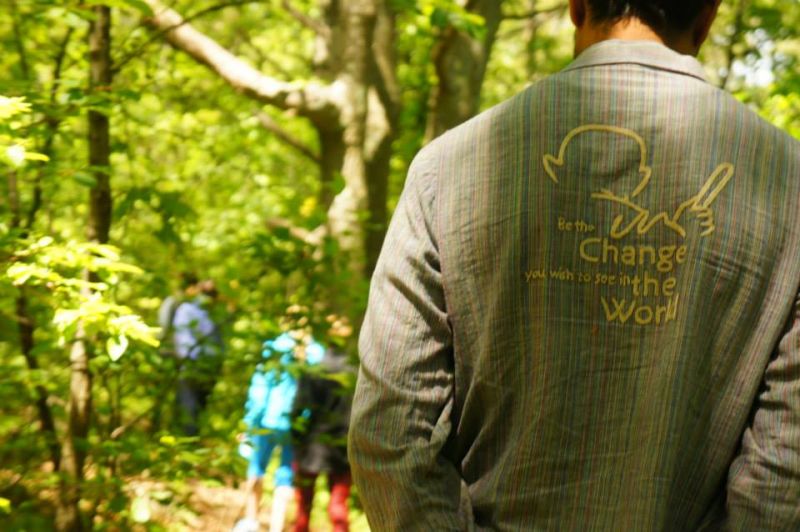
I recently returned from my first meditation retreat that was not in the SN Goenka tradition. Lots of learnings from this and I thought it would support me to process through writing. The retreat was in the tradition of Rev Heng Sure, who so many have been inspired by in our community. The retreat was their yearly 'Buddha Root Farm' retreat in rural Oregon (the picture above is the path to our campsite). Several folks in our ecosystem have attended before (including my partner!) but it was my first time.
Master Hua lecturing in 1975
Master Hua actually conducted the first retreat at this site in 1975, 13 years after arriving in the USA as one of the first people to bring Mahayana practice to the west. So many people in our community have shared about him and what he invited into existence (including an entire town, City of Ten Thousand Buddhas, +25 lineage locations globally, first-time text translations, and uncountable ripples). More recently, the retreat has been held yearly, including families and a pace that felt as much like a 'camp' as anything else.
This was not the '10 days of silence' process I was used to! I was intrigued to hear the spectrum of practice that this community can hold. Whether it was weekly 45 min meditations and sutra lectures on YouTube, or Buddha Root Farm-style retreats, or more intensive retreats (including a yearly 21 day meditation for 20 hours/day!) The point was not intensive for the sake of intensive, but rather to build the capacity to serve whatever the conditions that may arise.
The 'Half Can' for Food and Basic Needs
In addition to Rev Heng Sure, 5 other monastics were a part of the retreat - 3 monks and 2 nuns, who provided a sort of backbone to the daily activities. And the activities taken on were unique from my lens. While my background of familiarity with eastern traditions is more connected to Theravada Buddhism (along with a few Indian traditions eg Hinduism and Jainism), the lineage here is that of Mahayana Buddhism. In many ways, there are parallels with the monastic traditions of the others (eg eating once a day, living very simply, developing inner understanding), and in some key ways, there are shifts in framing. I wanted to outline my understanding of those shifts as I think they are meaningful, particularly from a ServiceSpace context.
The 'Chan' Hall for Practice
The growth of 'Eastern' ideas in the west seem strongly connected to the hippy movement in the USA, particularly focused on the coasts. Of course there were ideas that were shared earlier (eg Vivekananda's visit to the west 120 years ago), but a sort of mass rooting seemed to have begun in the 1960's. On the Buddhist side of that coin, that has led to a few viral memes that today, 50+ years later, seem to be all over the place. Interestingly, they seem to be components of Theravada Buddhism (mindfulness/sati) and Vajrayana Buddhism (tantra). It may not be commonplace to note that these 'memes' are from much larger schools of practice, but there it is :)
That being said, there are 3 major branches of Buddhism, not 2 - and the 3rd is Mahayana Buddhism, which is what Buddhism became as it traversed the Chinese subcontinent and onwards. Zen is a subcomponent (and its viral meme, zen as a design aesthetic :) For some reason the Chinese manifestation of Mahayana has really not grown in awareness in the west very much. Several potential reasons for that, including limited information sharing due to government, translation difficulty, the non-intuitive nature of the teachings, and the shift in focus of Chinese mainland practice towards 1 form of practice (chanting/mantra Pure Land practice).
After the Rains at Buddha Root Farm, Oregon
Because of this, I had little understanding of what I was in for in this retreat! So, I asked A LOT of questions :) Below is a bit more of where I'm standing at this point, recognizing that it is still very early in my journey here, but hopefully of some value to share.
3 key areas that strike me as major shifts from Theravada practice to Mahayana practice (without making anyone wrong)-
1- Maha Prajna Paramita
The Theravada canon consists of that which was written in the original language of Gautama the Buddha (Pali), although it was written long after Buddhas life. In the Mahayana canon, there are many more sutras/suttas that were put on paper after the Pali period (so the earliest text would be in Sanskrit or Mandarin). According to the Mahayana tradition, those sutras (or teachings) also included teachings which expanded on teachings of what was shared earlier for those who aspired to become Buddhas themselves. The earlier teachings focused on how to get free from suffering; the expanded teachings connected that freedom to all living beings.
One key grouping of teachings, consisting of about 40 sutras, is called the Maha Prajna Paramita, or the great perfection of wisdom. Of the many teachings therein, some of the most well-known are the Vajra (indestructible/diamond) sutra and the Heart sutra. In our retreat, we touched on these texts in particular. While difficult to summarize the takeaways using language (and there are others better suited anyways), a key piece to note here is the idea of emptiness as an abiding insight in parallel to sense-based experience. The teaching was shared via nested paradox. No becoming, no object/subject dichotomy, no linearity to time, and so on (including, eventually, no dharmas). Not as an intellectual concept but rather a lived experience. If you're interested in more, here's the original translation of Master Hua's text explanation (they are retranslating now because its missing a lot in old languaging)
In some cases, these sutras were discovered quite recently to the modern world. For instance, the Vajra sutra was virtually unknown until 1900 (!) and then unknown to the west until the 1960's.
Along with this insight was the naming of the possibility of so-called 'instant insight' (which of course is only instant from 1 vantage point), leading to stories like that of Master Hua's teacher, Master Empty Cloud and the canonical 6th Patriarch Sutra. The reason that Rev Heng Sure shared this (aside from it being meaningful given global situation currently) is that even if the insight cannot be lived moment-to-moment, there is a possibility of holding sense-based reality a little less tightly if there can be a tiny glimpse elsewhere.
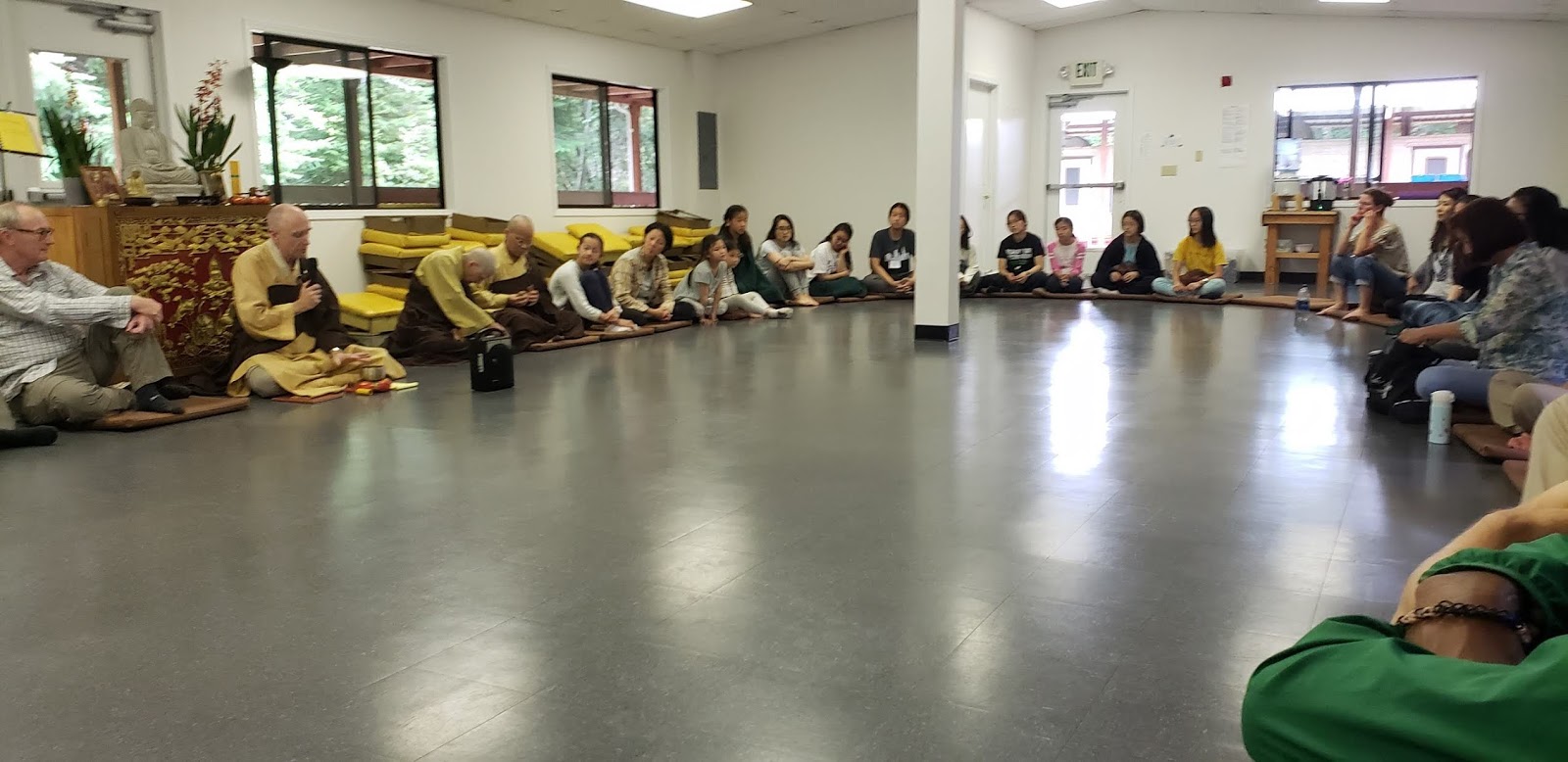
Rev Heng Sure (left) holding space in circle
2- Five Schools
In my Theravada practice, the key areas focused on sila (ethics), samadhi (concentration), and panna/prajna (insight). Here, forms of practice focus on 5 schools and 6 perfections. The five schools are chanting/Pure Land, Chan meditation, Vinaya (ethics/conduct), Sutra study, and 'Secret' school (matra/mudra/mandala). The 6 paramitas are generosity, ethics, patience, energy/vigor, concentration, insight. The variety of practice focus leads to many pathways of growth and reminded me of the multiple approaches to insight from a Vedic perspective (eg raja yoga, karma yoga, jnana yoga, bhakti yoga).
My upbringing was heavily influenced by my father, who I would say came from a rationalist, scientific, and atheist perspective (it has since evolved). Coming from this place, the Goenka ji tradition was exactly the one I was open to. It went out of its way to present a form of inner cultivation that a mind based on science, logic, and rationality could accept. And over the years, I've seen my energy field soften, and I've seen how a broad set of practices have supported (including Goenka vipassana). And so there I was, curious to practices of bowing, chanting, and beyond that I am open to in ways that I'm not sure I could have been earlier in my journey.
3- Bodhisattvas
Though the concept exists in Theravada, in Mahayana it is center stage. What's behind it is the approach of 'one vehicle' - that the enlightenment spoken of in earlier suttas, 'becoming' an arahant, is a step on the path, but not necessarily the end. In a universe imbued with interbeing, a personal enlightenment could be a partial one. In the Mahayana context, there is only one way through - the path of the Buddha. That is to say, we are all future Buddhas - not just whole in wisdom, but also whole in compassion. And what that means is taking on a path that honors that interconnection rather than pull back from it - through a path of service. A Bodhisattva takes on a vow to not cross the threshold of transcendance until all living beings first cross - and there are many such 'entities' beyond Gautama the Buddha. This doesn't negate the idea of a personal enlightenment, but rather 'enmeshes' the possibility that personal and collective aren't distinguishable at that level of insight.
There was an interesting story to this effect shared. A Bodhisattva was meditating and being bit by mosquitos. Simultaneously 3 directions of thought came up for the meditator - 1) a wish to expand the flesh of the body so that all the coming mosquitos could have their fill without issue; 2) an intention to bind to the consciousness of each mosquito such that those biters would be the first ones the meditator would take across the threshold of nirvana; 3) a holding of the paradox of the existence of the mosquitos, the meditators wish to 'liberate' the mosquitos, and a deeper emptiness where neither exists. This was a powerful story for me as any one of those perspectives seem a big stretch to hold!
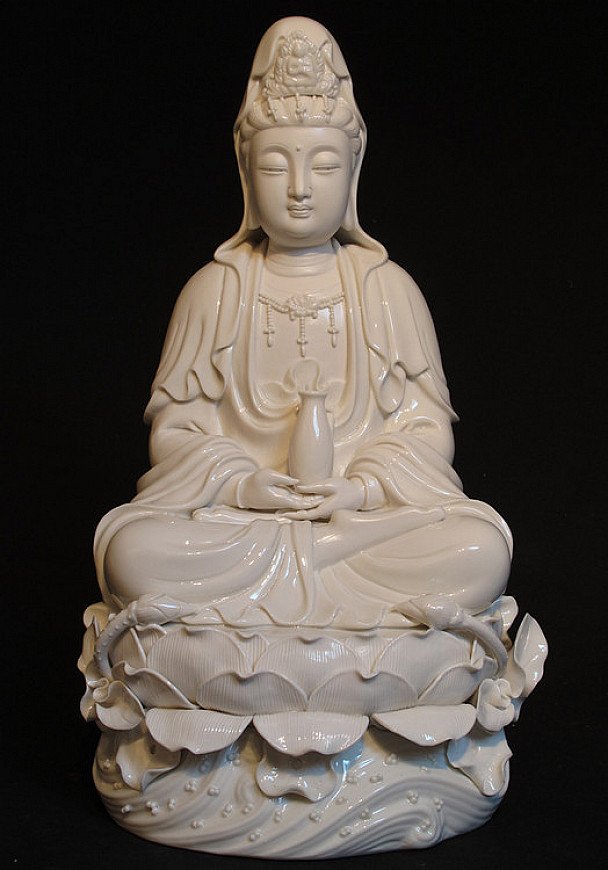
Guan Yin, like many Bodhisattvas, holding the feminine form in highlighting compassion
And like this, many Bodhisattvas, including perhaps the most well-known in the west, Guan Yin/Avalokiteshvar, who is known as the Bodhisattva of compassion. Each one taking vows that would (in theory) last eons, connecting 1:1 with the 'four noble truths' outlined by Gautama Buddha-
'Pithy' Noble Truths
1-The truth of suffering
2-The truth of the origination of suffering in attachment
3-The truth of the cessation of suffering through ending attachment
4-The truth of a path to follow that leads to this cessation
And since that language is pretty imprecise for what we're talking about-
More 'to the point' Noble Truths
1-Life is not constantly satisfactory
2-Reactivity to sense-experience causes this seemingly unavoidable dissatisfaction
3-Reactivity is not inherent, it can dissolve
4-There is a pathway for this to happen, its simple but not easy :)
Bodhisattva vows as correlating with the truths
1-Beings are numberless, I vow to save them.
2-Reactivities are inexhaustible, I vow to end them.
3-Opportunities for ending reactivities are boundless, I vow to master them.
4-The pathway laid before me is unsurpassed, I vow to become it.
Quite a powerful set of intentions to take on! Especially in a context where there are only 2 guiding forces for what one becomes - inertia/habit and vows. Mahayana in Society Today, and the ServiceSpace connection
My understanding is that part of the reason Theravada came earlier to the west is because of the openness of Southeast Asian countries - westerners were able to go visit Thailand and Burma etc, and coming back became the Jack Kornfields and Sharon Salzbergs we now know. Similarly, my understanding is Vajrayana came to the west because His Holiness the Dalai Lama became a sort of political and spiritual leader beyond that of the country he was displaced from. From that came the Richard Davidsons and Richard Geres. And of course we have Zen as a Mahayana 'offshoot' that became well-known through folks like Phil Jackson (although the tradition shifted significantly away from its previous tenets due to Japan governmental policy in late 1800's). But, when it comes to broader Mahayana, we in the west do not seem to have such iconic names or concepts, at least to my eyes.
This is interesting to me because there are several aspects of Mahayana practice that feel deeply resonant to me. I'm also noticing how much the world of ServiceSpace seems aligned with this approach. It seems to me that of a few different ideas that could spread through society from this tradition, highest potential could be the Bodhisattva concept.
From a ServiceSpace perspective, the parallels with a Bodhisattva approach are strong. The intention of selfless/empty service outlined both through the Vajra sutra text as well as through Bodhisattva vows feels deeply connected to concepts such as 'pilgrim heart', 'change yourself, change the world', and 'laddership.' The 6 paramitas lead with generosity, patience, and vigor, key components of 'gift culture.' It adds up to an invitation to serve, not from the perspective of benefit for the 'other', or to 'save the world', or even to 'enlighten oneself', but for insight into transcendence. Cultivating within and service to others becomes 2 sides of the same coin. To parallel the paradox of the Vajra text, there is nobody who serves and nobody to serve, that is why it is called service :)
And all of this is held by Rev Heng Sure as an elder in the ServiceSpace ecosystem. I have witnessed him, heard stories about him, his bowing pilgrimage, and personally benefited from his presence for many years, yet I hadn't grasped the more specific underpinnings of the tradition he has been cultivating in for +40 years. What I found in holding that inquiry felt so alive that I thought others may also appreciate some of the fruit!
In closing, below is the 'song' that has become ubiquitous in this tradition. Sung daily to close activities, it carries an intention of sharing everything that one is/has for the benefit of others, even intangible merit, so that all beings may be happy and free :)